Enterprise headless without a DXP: why AI agents can replace the $100K platform
Most enterprise marketing sites do not need a six-figure DXP or headless CMS program to get headless performance: a statically generated site, built, reviewed and maintained by AI agents with one agent per function and human approval on every change, delivers faster pages, stronger SEO and GEO and more rigorous experiments for a fraction of the licence and team cost. PlanConversion runs its own site of more than 1,200 pages on this model and builds the same function for enterprise teams.
Key takeaways
- Enterprise tiers of Contentful, Contentstack, Sanity, Storyblok, Builder.io, Optimizely, Sitecore and Adobe AEM are all "contact sales"; Vendr reports median annual licence contracts of $53,288 to $81,447 for Contentstack, Contentful, Sitecore and Optimizely, before implementation.
- Headless is the foundation for SEO and GEO because frameworks such as Next.js ship complete HTML, metadata, schema and sitemaps at build time, and in Vercel’s 2024 measurements none of the major AI crawlers rendered JavaScript.
- The saving is not a cheaper tool. It is a different operating model: agents per function (content, SEO, GEO, accessibility, design QA, performance, experimentation, tracking QA), review gates, and people only for approvals.
- Experimentation moves into the build: no separate testing licence, edge splits instead of a client-side snippet, and success read in CRM pipeline rather than clicks.
- A commercial CMS or DXP still makes sense for large editorial teams, heavy localization workflows and regulated approvals; the agent route needs branch protection, code ownership and security controls from day one.
What does an enterprise headless CMS or DXP cost in 2026?
Enterprise pricing is not published by any of the major vendors. Every one of them puts its enterprise tier behind a sales conversation, so the only public reference points are entry plans and third-party contract data. The table below shows what each vendor published on November 9, 2026.
| Platform | Published entry pricing | Enterprise tier | Third-party contract data |
|---|---|---|---|
| Contentful | Free; Lite at $300 per month (20 users) | Custom, contact sales | Vendr median $54,173 per year (167 purchases), range $24,050 to $128,183 |
| Contentstack | Free; Build $29 and Growth $299 per month | Custom, contact sales | Vendr median $53,288 per year, range $17,296 to $171,060 |
| Sanity | Free; Growth $15 per seat per month | Custom, contact sales | Not used here |
| Storyblok | Free; Growth $99 and Growth Plus $349 per month (billed monthly) | Premium and Elite: custom, contact sales | Not used here |
| Builder.io | Free; Pro $24 and Team $40 per user per month | Custom, contact sales | Not used here |
| Optimizely (Experimentation and CMS) | None published | Personalized quote | Vendr median $81,447 per year (126 purchases), range $26,460 to $261,075 |
| Sitecore XM Cloud (now part of SitecoreAI) | None published | Contact sales | Vendr median for Sitecore $60,944 per year, range $8,687 to $396,007 |
| Adobe Experience Manager Sites | None published | "Get customized pricing" | No AEM-specific figure; Vendr reports $63,788 per year across all Adobe purchases |
Two things stand out. First, the entry plans are not what an enterprise buys: custom roles, locales, SSO, governance and support live in the contact-sales tier. Second, the Vendr figures cover the licence only. Implementation partners, the internal team that runs the platform and separate experimentation or personalization licences come on top, and credible public figures for implementation do not exist, so quotes vary widely by scope. Once those are added, a first-year program above $100,000 is common, and Vendr's own high-end licence figures pass that line before any build work starts.
This article is the pillar of a five-part series. For a vendor-by-vendor view, read our comparison of agent-run headless vs Contentful, Storyblok, Sanity and DXP suites.
DXP route vs agent-run headless: cost and operating model compared
The question is not which CMS to buy. It is who builds, checks and changes the site every week, and what that costs in licences, partners and people. Our guide on when a headless CMS pays off covers the architecture decision; this comparison covers the operating model.
| Dimension | Traditional DXP or enterprise headless CMS route | Agent-run headless |
|---|---|---|
| Licences | Enterprise CMS or DXP contract, contact sales; Vendr medians $53,288 to $81,447 per year for the vendors above, often plus a separate experimentation or personalization licence | Open-source framework (Next.js, Astro, Nuxt or SvelteKit), static hosting, a Git host and AI agent usage; no per-editor CMS seats unless you add a light content source |
| Implementation | Partner-led build; quotes vary widely and are rarely published | Built in sprints by AI coding agents under senior review; the code lives in your own repository |
| Team | Platform developers, a CMS administrator, a partner retainer and marketers trained on the platform | A small senior team that reviews and approves; agents do the building, checking and maintenance |
| Time to ship a change | Content edits are fast; template, schema or component changes go through a developer or partner queue | An agent opens a pull request with a preview link; specialist review agents check it; a person approves the merge |
| Experimentation | Client-side testing tool or bundled DXP module, separate contract | Server or edge split tests with pre-registered metrics tied to CRM pipeline; agents build variants and write the readout |
| Performance | Depends on the build; client-side scripts, tag managers and testing snippets often add weight | Static HTML from the edge, a performance budget enforced on every pull request |
| SEO and GEO | Configured per template; schema and llms.txt often added later | Metadata, canonicals, schema, sitemaps and llms.txt generated from the content model at build time |
The licence line is the visible saving. The larger one is people time: in the agent-run model, specialists stop doing repetitive build and QA work and spend their hours on the decisions only they can make.
Why headless is the foundation for SEO and GEO
When companies adopt new web technology, search and AI visibility should be a deciding factor, not an afterthought, and it is the core of any generative engine optimization effort. A headless front end built on a modern framework is the strongest foundation we know for both, because the framework produces exactly what crawlers and AI agents need at build time.
The reason is mechanical. A crawler or AI agent should get the whole answer in the first response. Static generation in Next.js, Astro, Nuxt or SvelteKit writes that HTML once, at build time; a client-rendered page asks every bot to run JavaScript first, and Google notes that not all bots can. AI crawlers are the strictest case: in Vercel’s December 2024 measurements, none of the major AI crawlers it tracked rendered JavaScript.
There is no separate rulebook for AI search to buy your way into. Google says AI Overviews and AI Mode have no extra requirements beyond being indexed and eligible for a snippet, so the job is to make the SEO basics systematic. A headless build does that by generating them from code, which is the difference between a site that is optimized once and a site that stays optimized.
- Fast Core Web Vitals: static pages served from the edge make it easier to hit the "good" thresholds web.dev sets at the 75th percentile (LCP within 2.5 seconds, INP of 200 milliseconds or less, CLS of 0.1 or less).
- Clean semantic markup: components output real headings, lists and tables, which is also what accessibility checks need.
- Structured data from the content model: Article, FAQPage, Organization and BreadcrumbList generated from the same fields that render the page, so schema always matches the visible text.
- Metadata and canonicals at build time: per-page titles, descriptions, canonicals and hreflang are computed once, not typed into a CMS field and forgotten.
- Sitemaps and llms.txt generated automatically: Next.js has a sitemap file convention, and the llms.txt proposal (an open proposal, not a ratified standard) gives AI agents a markdown overview of the site.
- Edge delivery: a static build deploys to a CDN, so every page is fast everywhere without a page cache to tune.
We build fast, structured B2B sites with tracking, schema and answer-ready pages.
The architecture: one agent per function, review gates and human approvals
Agent-run headless has five layers. Each one is simple on its own; the value comes from separating the functions so each can work, and fail, independently.
The design principle is that agents do the building and the checking, and people do the deciding. Our article on the AI agent web team operating model covers roles, approval rights and service levels in detail.
- Content as code, or a light content source: pages live as typed content files in the repository, versioned with the templates. Teams with many non-technical editors can add a light headless source for specific content types without moving the whole site onto a DXP.
- Static generation at the edge: the framework builds every page to HTML at deploy time and the host serves it from a CDN. Changed URLs are submitted to search engines on deploy, for example through IndexNow.
- One agent per function: content, SEO, GEO, accessibility, design QA, performance, experimentation and tracking QA each have their own agent, instructions and pass criteria. A content agent does not grade its own SEO.
- Review gates: every change arrives as a pull request with a preview. Specialist review agents check design, UX and CRO, accessibility, SEO and GEO, claims and performance budgets, and block the merge when a check fails.
- Notifications to people only for QA and approvals: the right owner gets a message when a decision is needed (a claim to approve, a test to launch, a merge to sign off), not a stream of status updates. Merges require human approval through branch protection.
Scheduled agents keep the site healthy between changes: daily SEO health checks, AI crawler access checks, indexing requests and weekly CRO reviews that turn findings into proposed pull requests.
What happens to experimentation when the DXP goes
Testing is one of the main reasons enterprises keep a DXP or add a separate experimentation licence. Optimizely publishes no prices, and Vendr reports a median Optimizely contract of $81,447 a year. Google’s free option, Optimize, stopped working on September 30, 2023. Yet a serious conversion rate optimization program does not need a testing product at all.
In the agent-run model, testing becomes part of the build rather than a product bolted onto it. Variants are prebuilt pages, traffic is split at the edge before the page is sent, and the result is read in the CRM, not in a testing dashboard. The statistics do not get easier: B2B traffic is thin, so the sample size is fixed before launch. Our article on A/B testing without an experimentation platform gives the full method, with a worked sample-size calculation.
- What you stop paying for: a separate testing licence, and the client-side snippet that slows every page it touches.
- What you keep: written hypotheses, guardrail metrics, a pipeline metric chosen before launch and a person who decides what ships.
- What agents add: variants built as reviewed pull requests, tracking checked before launch and a written readout on the planned end date.
When a commercial headless CMS or DXP still makes sense
Agent-run headless is not the right answer for every enterprise. A commercial platform earns its licence when the work is mostly editorial and governed, not technical. The vendor comparison in this series covers the editorial cases: many daily non-technical publishers, vendor-run localization, CDP-fed personalization and contractual data residency.
Two governance cases deserve a mention here, because they settle the question before cost does.
- Audit requirements: if auditors expect a vendor-certified audit trail and role model, a commercial platform may be simpler to defend than Git history, even though Git records more.
- Regulated approvals: pharmaceutical, financial services and similar teams with formal medical, legal or compliance sign-off often need that workflow inside the authoring tool, where reviewers already work.
Even then, the hybrid often wins: keep a commercial CMS for the editorial content types that need it, and run templates, SEO, GEO, performance, QA and experiments with agents in the front-end repository.
Risks of an agent-run site and how to control them
Agents that can change a production website need the same controls as a development team, and a few more. These are the risks we plan for in every build.
| Risk | What goes wrong | Control |
|---|---|---|
| Governance | An agent change reaches production without a person seeing it | Branch protection, required human approval on every merge, preview links and a clear owner per area |
| Code ownership | The site depends on an agency or a tool you do not control | The repository, hosting and domains sit in your own accounts; agent instructions and checks are versioned in the repository |
| Review discipline | Approvals become rubber stamps once volume grows | Specialist review agents with written pass criteria, small pull requests and sampled human audits |
| Model dependency | A model changes behaviour or price | The site is plain code that runs without any agent; instructions and tests are model-agnostic, so agents can be swapped |
| Security | Leaked secrets, unsafe dependencies or instructions hidden in fetched web content | Least-privilege tokens, no production secrets for agents, dependency scanning, and fetched content treated as data, never as instructions |
| Claims and compliance | Copy states a number or partnership that is not approved | A claims file of approved proof, a claims review agent on every pull request and legal sign-off where required |
How to move from a DXP to agent-run headless in 90 days
Most of the risk in a migration sits in content parity, redirects and tracking, not in the new stack. This sequence moves those risks forward and fits inside one quarter for a typical enterprise marketing site.
- Weeks 1 to 2, audit: inventory pages, templates, traffic, rankings, integrations, forms and CRM tracking, and note the licence renewal and notice dates.
- Weeks 2 to 4, content model and repository: define content types as typed files or a light content source, build the design system components and set branch protection and approval rules.
- Weeks 3 to 6, templates: build page templates with static generation, and generate metadata, canonicals, hreflang, schema, sitemaps, llms.txt and the full redirect map from the content model.
- Weeks 4 to 8, agents and gates: set up one agent per function, the review board on pull requests and notification routing so owners only hear about approvals and QA.
- Weeks 6 to 10, migration: agents move content in batches, with automated parity checks for copy, links, schema and redirects, and tracking QA against CRM fields.
- Weeks 10 to 12, launch: run the new site in parallel on a preview domain, cut over, submit changed URLs, monitor Search Console and Core Web Vitals, and start the first pre-registered experiment.
- Before the renewal date: confirm parity and pipeline tracking, then let the DXP licence lapse or reduce it to the content types that still need it.
How PlanConversion builds an agent-run web function, not another tool
We do not hand you another platform to learn. PlanConversion builds the whole function through our headless website development service: the site, one agent per function, the review gates and the approval routing, set up in your accounts. The saving shows up in three places: licence cost, build time and the human hours your team spends on repetitive work.
The agents come from our AI adoption and process optimization work: each one has written instructions, pass criteria and an owner, and none of them can merge on its own. Your team keeps the decisions; the agents keep the site built, checked and current.
We run our own site the same way: a static Next.js site of more than 1,200 pages in English, French and Italian, where agents change pages through pull requests, a review board of specialized agents checks each one, and a person approves every merge.
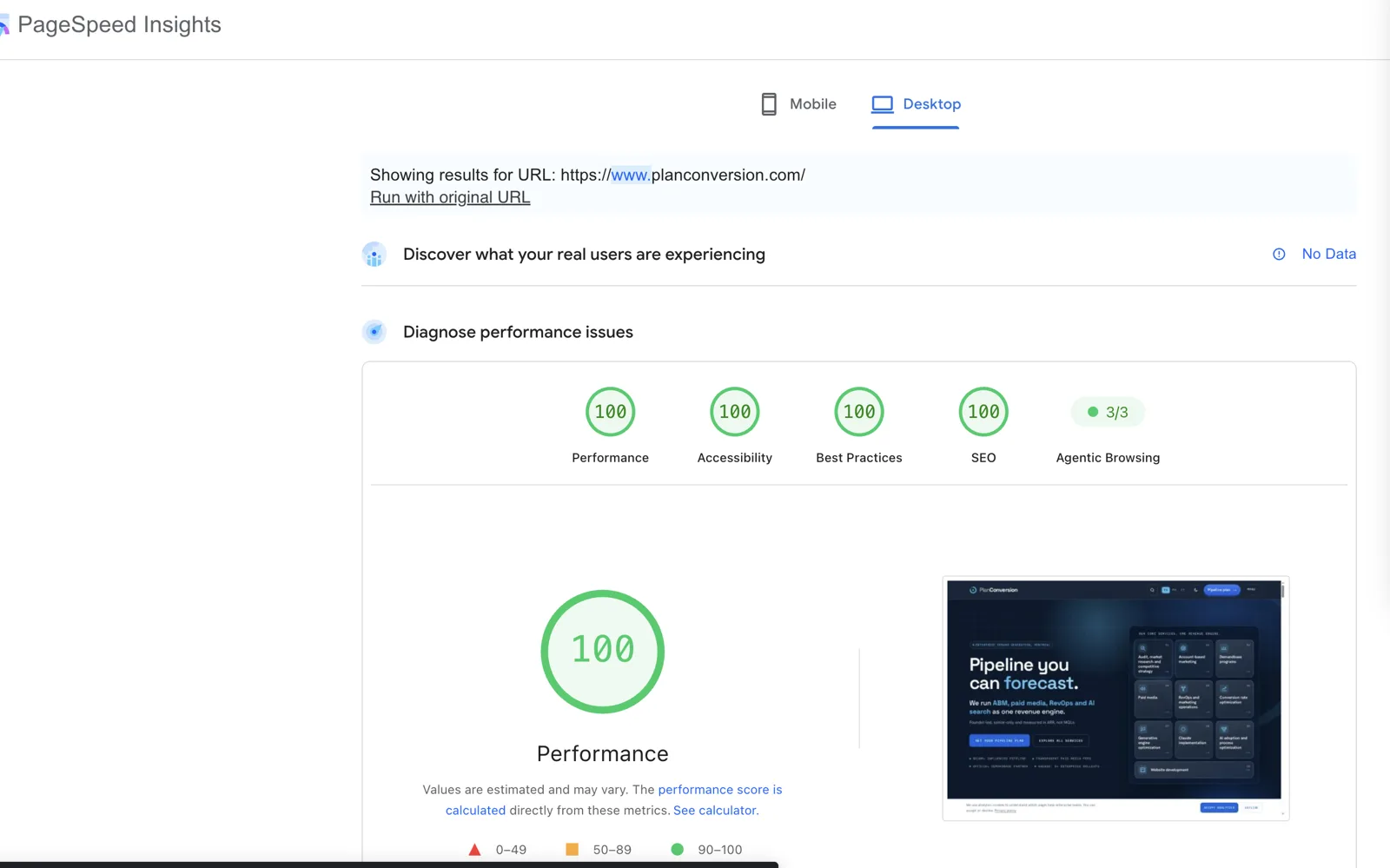
The results on our own homepage: on PageSpeed Insights (desktop, measured November 9, 2026) planconversion.com scores 100 for Performance, 100 for Accessibility, 100 for Best Practices and 100 for SEO, plus 3 of 3 on Agentic Browsing. After fixing two small tap-target issues the same day, our best mobile Lighthouse runs scored 98 on the homepage and 99 on a blog article for Performance, with 100 for Accessibility, Best Practices and SEO; a service page scored 99 for Performance and 97 for Accessibility on mobile. Desktop Lighthouse returned 100 in all four categories on the homepage, an article and a service page. Lab scores vary from run to run, so treat them as a snapshot rather than a guarantee. Field data matters more, and only 48% of mobile sites and 56% of desktop sites passed all Core Web Vitals in 2025, according to the HTTP Archive Web Almanac.
Our case study on how we scored 100 on PageSpeed Insights explains what we changed and in which order.
This is how we built and run our own site. If you want the same results, talk to our team and we will come back with a full solution for your stack.
Frequently asked questions
Can an enterprise really run its website without a DXP?
Yes, for most marketing sites. A statically generated headless site with agents for content, SEO, GEO, accessibility, design QA, performance, experimentation and tracking QA, plus human approval on every merge, covers what most marketing teams use a DXP for. Large editorial teams and regulated approval workflows are the main exceptions.
How much does an enterprise headless CMS or DXP cost?
Enterprise tiers are contact sales at every major vendor. Vendr reports median annual contracts of $54,173 for Contentful, $53,288 for Contentstack, $81,447 for Optimizely and $60,944 for Sitecore, for the licence only. Implementation quotes vary widely and are rarely published.
Why is headless the foundation for GEO and not only SEO?
AI crawlers are less forgiving than Google. Vercel found in 2024 that none of the major AI crawlers it measured rendered JavaScript, so content must be in the HTML. Static generation puts it there, and metadata, schema, sitemaps and llms.txt are generated from the content model on every build.
Do we need a separate experimentation licence?
Usually not for a B2B marketing site. Variants are built as reviewed pull requests, traffic is split at the edge, and results are read against CRM pipeline. A platform still pays off for high-traffic sites running many tests at once.
Who approves changes on an agent-run website?
People do. Agents open pull requests with preview links, specialist review agents check them, and branch protection requires a named human approver before anything merges. Owners are notified only when a decision or QA step needs them.
What happens if we stop using the AI agents?
The site keeps working. It is plain framework code in your own repository and hosting accounts, so any development team can maintain it, and the agent instructions and checks are versioned files that can move to another model.
Sources
- Contentful: Pricing (checked 2026-11-09)
- Contentstack: Pricing (checked 2026-11-09)
- Sanity: Pricing (checked 2026-11-09)
- Storyblok: Pricing (checked 2026-11-09)
- Builder.io: Pricing (checked 2026-11-09)
- Optimizely: Plans (checked 2026-11-09)
- Sitecore Developer Portal: XM Cloud pricing FAQ (XM Cloud transitioned into SitecoreAI)
- Adobe: Experience Manager Sites pricing (checked 2026-11-09)
- Vendr: Contentful software pricing (checked 2026-11-09)
- Vendr: Contentstack software pricing (checked 2026-11-09)
- Vendr: Optimizely software pricing (checked 2026-11-09)
- Vendr: Sitecore software pricing (checked 2026-11-09)
- Vendr: Adobe software pricing (checked 2026-11-09)
- Next.js docs: Static exports
- Next.js docs: sitemap.xml file convention
- Google Search Central: Understand JavaScript SEO basics
- Google Search Central: AI features and your website
- Vercel: The rise of the AI crawler (December 17, 2024)
- llms.txt: proposal by Jeremy Howard (Answer.AI)
- web.dev: Web Vitals
- HTTP Archive Web Almanac 2025: Performance
- Google Analytics Help: Google Optimize sunset
Related service: Website development. See also pricing and client results.
We run enterprise B2B demand generation for teams in Montreal, Toronto, Ottawa and the United States.